
What is Cloud Computing? A Simple Guide for Students
Technology has changed the way we store, access, and use information. Instead of keeping everything only on our computers or phones, we can now access files, applications, and services through the internet.
This technology is called cloud computing.
Cloud computing is used every day by students, teachers, businesses, developers, and organizations around the world. Understanding its basic concepts can help students build important technology knowledge for the future.
What is Cloud Computing?
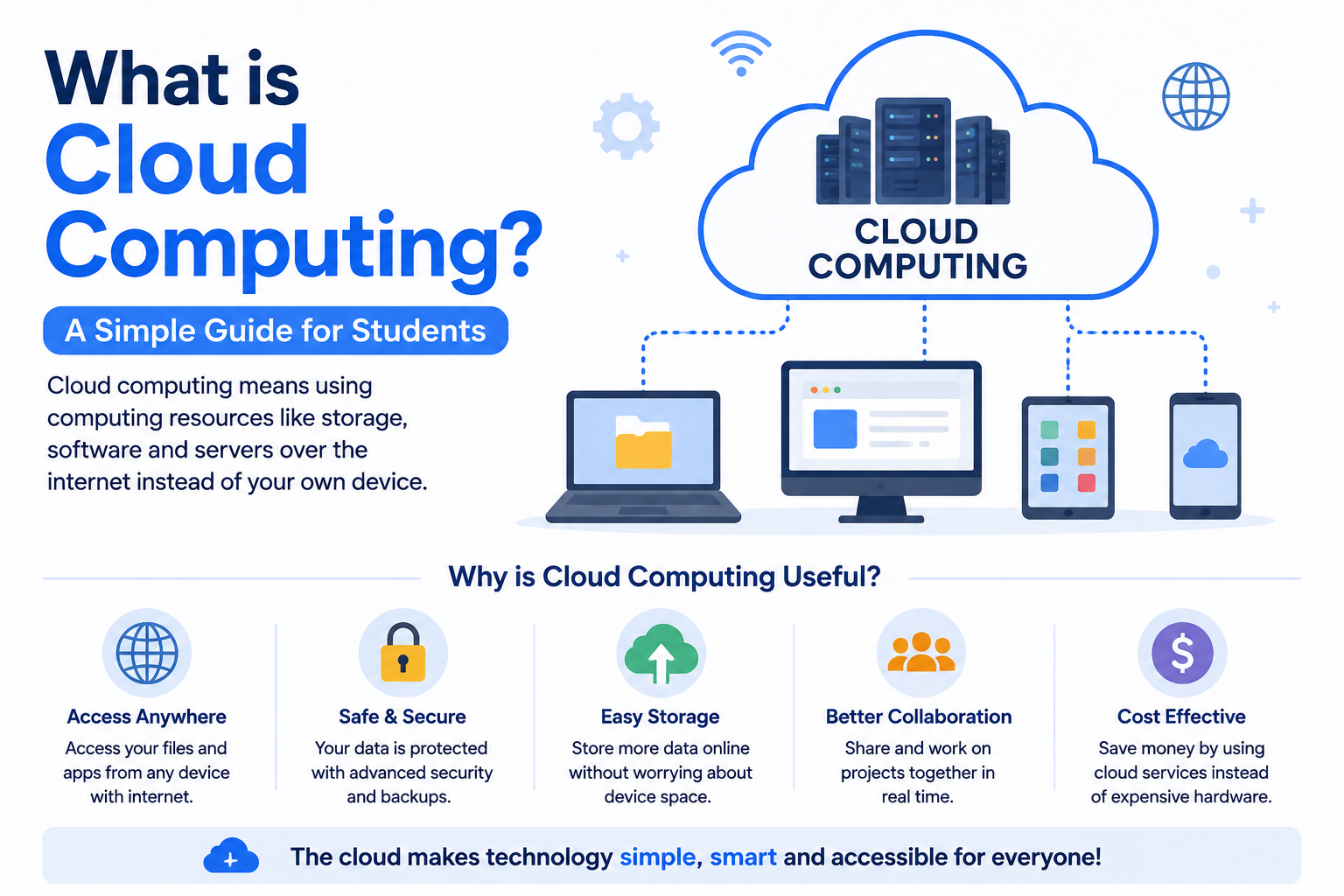
Cloud computing means using computing resources such as storage, software, servers, databases, and processing power through the internet.
Instead of relying completely on your own computer, you can use resources provided by cloud platforms.
For example, when you save a document online and access it later from another device, you are using cloud-based technology.
How Does Cloud Computing Work?
Cloud computing works through remote computers called servers.
These servers are located in data centers and are connected to the internet.
When you use a cloud service:
- You connect to the service through the internet.
- Your request is sent to remote servers.
- The servers process the request.
- The required information or service is sent back to you.
This allows users to access computing resources without managing the physical infrastructure themselves.
Simple Example of Cloud Computing
Imagine you are working on a school project.
You create a document and save it to a cloud storage service.
Later, you can open the same document from:
- A laptop
- A desktop computer
- A tablet
- A smartphone
You don't need to carry the original file between devices.
This is one of the simplest examples of how cloud computing makes technology more convenient.
Where Do Students Use Cloud Computing?
Students may already use cloud computing without realizing it.
Common examples include:
- Online document editors
- Cloud storage
- Online classrooms
- Video meeting platforms
- Email services
- Online learning platforms
- Collaborative project tools
- Online coding environments
Cloud technology makes it easier for students to learn and work from different devices.
Benefits of Cloud Computing
Cloud computing provides several important benefits.
Easy Access
Files and applications can be accessed from different devices with an internet connection.
Collaboration
Multiple people can work on the same project or document, making teamwork easier.
Storage
Students can store files online without depending entirely on their device's storage.
Scalability
Cloud resources can be increased or reduced depending on requirements.
Cost Efficiency
Organizations can use computing resources without purchasing and maintaining all the required physical infrastructure themselves.
Types of Cloud Computing
Students may come across three major types of cloud services.
Infrastructure as a Service
Infrastructure as a Service, or IaaS, provides computing resources such as virtual machines, storage, and networking.
Platform as a Service
Platform as a Service, or PaaS, provides an environment where developers can build and deploy applications without managing all the underlying infrastructure.
Software as a Service
Software as a Service, or SaaS, provides software applications through the internet.
Online productivity tools and many web-based applications are examples of SaaS.
Public, Private, and Hybrid Clouds
Cloud environments can also be categorized based on how they are managed.
Public Cloud provides services through cloud providers and is shared among multiple customers.
Private Cloud is designed for use by a specific organization.
Hybrid Cloud combines public and private cloud environments.
These models allow organizations to choose cloud infrastructure based on their requirements.
Why Should Students Learn Cloud Computing?
Cloud computing is an important part of modern software development and digital services.
Learning its basics can help students understand:
- How modern applications work
- How online services store information
- How websites and applications are hosted
- How developers deploy software
- How businesses use technology
- How large-scale applications operate
It also provides a foundation for learning more advanced areas of computer science.
Cloud Computing and Programming
Cloud computing and programming work closely together.
Developers can use cloud platforms to:
- Host websites
- Deploy applications
- Store databases
- Run programs
- Build APIs
- Process data
- Develop AI applications
Students who already know programming can gradually explore how their applications can be deployed and used through cloud platforms.
Cloud Computing and AI
Modern Artificial Intelligence systems often rely on cloud infrastructure.
Cloud platforms can provide the computing power and storage needed to develop and run AI applications.
This means students interested in AI can eventually learn how cloud technology supports:
- Machine Learning
- Data Processing
- AI Applications
- Model Training
- Intelligent Software
Cloud computing is therefore an important technology behind many modern AI services.
Skills Students Can Develop
Learning about cloud computing encourages students to develop:
- Technical knowledge
- Problem-solving skills
- Digital literacy
- Understanding of computer networks
- Programming knowledge
- System thinking
- Technology awareness
These skills can support future learning in software development, cybersecurity, AI, data science, and other technology fields.
Future Careers in Cloud Computing
Students who develop cloud computing skills can explore careers such as:
- Cloud Engineer
- Cloud Architect
- DevOps Engineer
- Software Developer
- Cloud Security Engineer
- Systems Administrator
- Data Engineer
- Solutions Architect
Cloud knowledge can also complement careers in AI, cybersecurity, software development, and data science.
How Students Can Start Learning
Students don't need to become cloud experts immediately.
A good learning path is:
- Learn basic computer concepts.
- Understand how the internet works.
- Learn basic programming.
- Understand servers and databases.
- Explore cloud storage and online services.
- Learn basic cloud computing concepts.
- Try simple cloud-based projects.
Starting with fundamentals makes advanced cloud topics much easier to understand.
Learn Technology Through Projects
The best way to understand technology is by applying concepts to practical projects.
Students can gradually explore projects such as:
- Cloud-based portfolio websites
- Online file storage applications
- Simple web applications
- Cloud-hosted databases
- Online collaboration projects
Project-based learning helps students connect theoretical concepts with real-world technology.
Conclusion
Cloud computing has become an essential part of modern technology. From storing files and using online applications to hosting websites and powering Artificial Intelligence, cloud services are used in many areas of everyday life.
For students, understanding cloud computing provides a strong foundation for exploring software development, AI, data science, cybersecurity, and other future technology fields.
Learning the basics today can help students become more confident and prepared for tomorrow's digital world.