
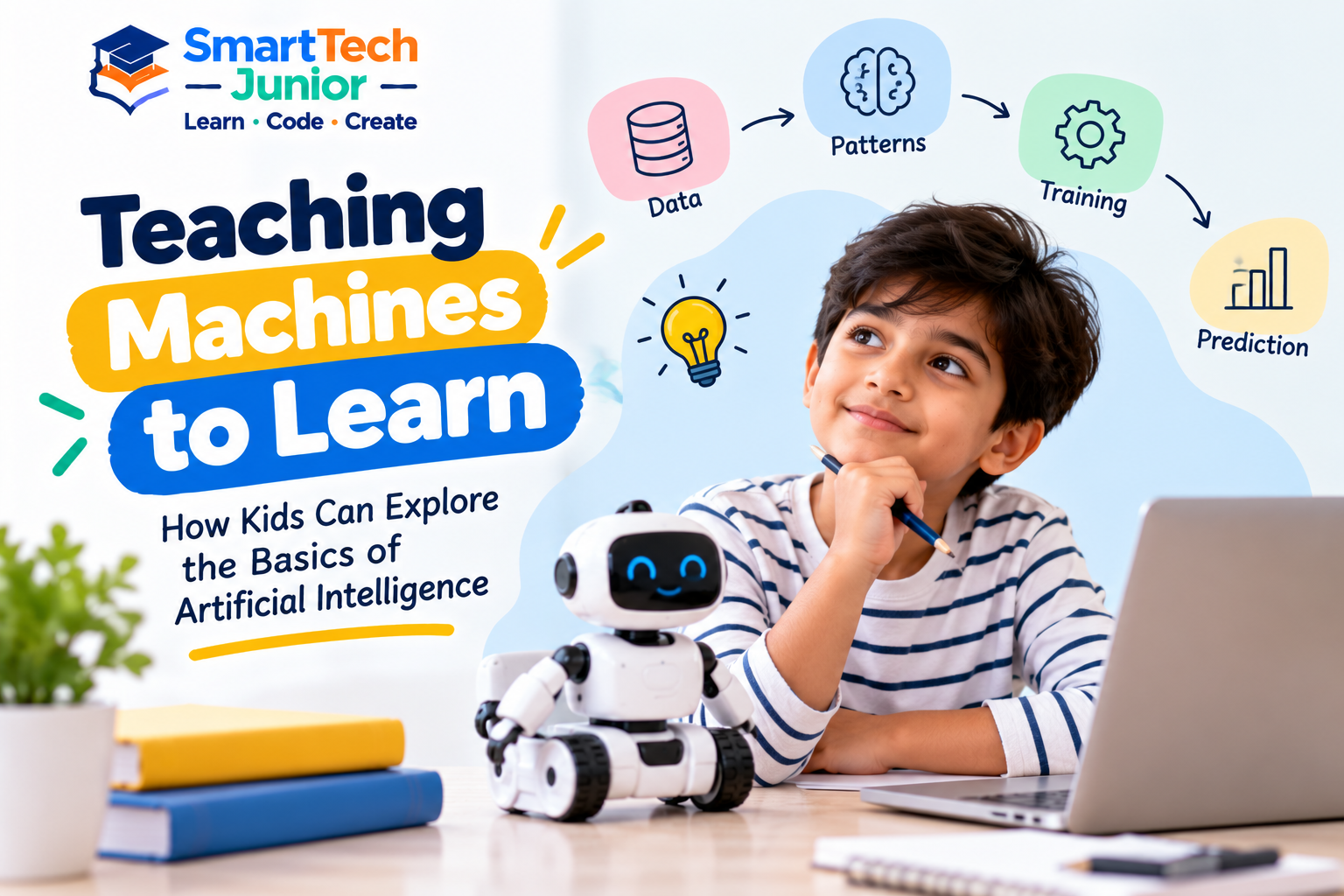
Teaching Machines to Learn: How Kids Can Explore the Basics of Artificial Intelligence
Artificial Intelligence is becoming part of many technologies children interact with every day. From recommendation systems to image recognition and intelligent applications, AI allows computers to perform tasks that traditionally required human decision-making.
But how do machines actually learn?
Introducing children to the basic ideas behind Artificial Intelligence can help them understand the technology they are already surrounded by and encourage them to become creators rather than only users.
What Does It Mean for a Machine to Learn?
Traditional computer programs usually follow instructions written by a programmer.
Machine learning introduces a different approach.
Instead of explicitly programming every possible situation, a machine learning system can learn patterns from data and use those patterns to make predictions or decisions.
For example, imagine showing a computer many pictures of different animals.
If the system receives suitable training data, it can learn patterns that help it distinguish between different types of animals.
The important idea for children is simple:
Machines can learn patterns from data.
Data Is an Important Part of AI
Artificial Intelligence depends heavily on data.
Data can include:
- Images
- Text
- Numbers
- Audio
- Sensor information
- User activity
Students can learn that the quality and type of data used to train a system can affect how well the system performs.
This introduces an important concept: computers do not simply become intelligent by themselves. They need information and suitable methods to learn from it.
How Does Machine Learning Work?
Children can understand machine learning through a simple learning process.
1. Collect Data
First, information is gathered for the problem the system needs to solve.
2. Prepare the Data
The data may need to be organized and cleaned so that it can be used effectively.
3. Train the Model
A machine learning algorithm looks for patterns within the training data.
4. Test the Model
The trained model is tested using data it has not previously seen.
5. Make Predictions
Once trained, the model can use what it learned to make predictions on new data.
This basic workflow gives students an introduction to how real machine learning systems are developed.
Learning Through Simple AI Projects
AI becomes easier to understand when students can experiment with it.
Young learners can explore beginner-friendly projects such as:
- Image classification
- Simple recommendation systems
- Text classification
- Object recognition
- Voice-based experiments
- Basic prediction projects
The goal is not to make children experts in machine learning immediately.
Instead, projects can help them understand how data, algorithms, models, and predictions connect together.
AI Encourages Problem-Solving
Building an AI project involves more than writing code.
Students need to think about the problem they are trying to solve.
They may ask:
What data do we need?
What patterns should the computer identify?
How can we test the result?
Why did the model make a wrong prediction?
These questions encourage analytical thinking and help students approach technology as a problem-solving tool.
Understanding That AI Can Make Mistakes
An important part of learning AI is understanding that an AI system is not always correct.
A model can make incorrect predictions because of:
- Limited training data
- Poor-quality data
- Incorrect assumptions
- Unbalanced examples
- Complex real-world situations
Teaching children about these limitations helps them develop a more realistic understanding of Artificial Intelligence.
They learn that AI systems need to be tested, evaluated, and improved.
Connecting AI with Coding
Coding provides an important foundation for exploring AI.
Programming allows students to work with data, build algorithms, process information, and create applications that use machine learning models.
As children progress, they can move from simple programming concepts toward more advanced areas such as:
- Data processing
- Machine learning
- Natural language processing
- Computer vision
- AI applications
This creates a gradual learning path from programming fundamentals toward Artificial Intelligence.
Why Should Kids Learn About AI?
AI education can help children understand one of the technologies shaping the modern world.
Through AI learning, students can develop:
- Computational thinking
- Data awareness
- Logical reasoning
- Problem-solving
- Programming skills
- Analytical thinking
- Creativity
- Responsible technology awareness
More importantly, they begin to understand that AI is something they can learn, experiment with, and eventually build.
Learning AI at SmartTech Junior
At SmartTech Junior, students can explore Artificial Intelligence through age-appropriate concepts, coding, and practical projects.
Rather than approaching AI only as a theoretical subject, students can gradually explore how data, patterns, algorithms, and models contribute to intelligent systems.
Hands-on projects can give learners an opportunity to experiment, ask questions, test ideas, and understand how AI technologies work.
From Using AI to Understanding AI
Children are growing up in a world where Artificial Intelligence is becoming increasingly common.
Learning about AI gives them an opportunity to look beyond the surface.
Instead of simply asking “What can AI do?”, they can begin asking:
“How does AI learn?”
“Where does the data come from?”
“How does a machine recognize patterns?”
“Can I build an AI project myself?”
These questions can be the beginning of a much deeper journey into technology.
Artificial Intelligence education is not only about teaching machines to learn. It is also about helping children learn how to think, experiment, solve problems, and create with technology.