
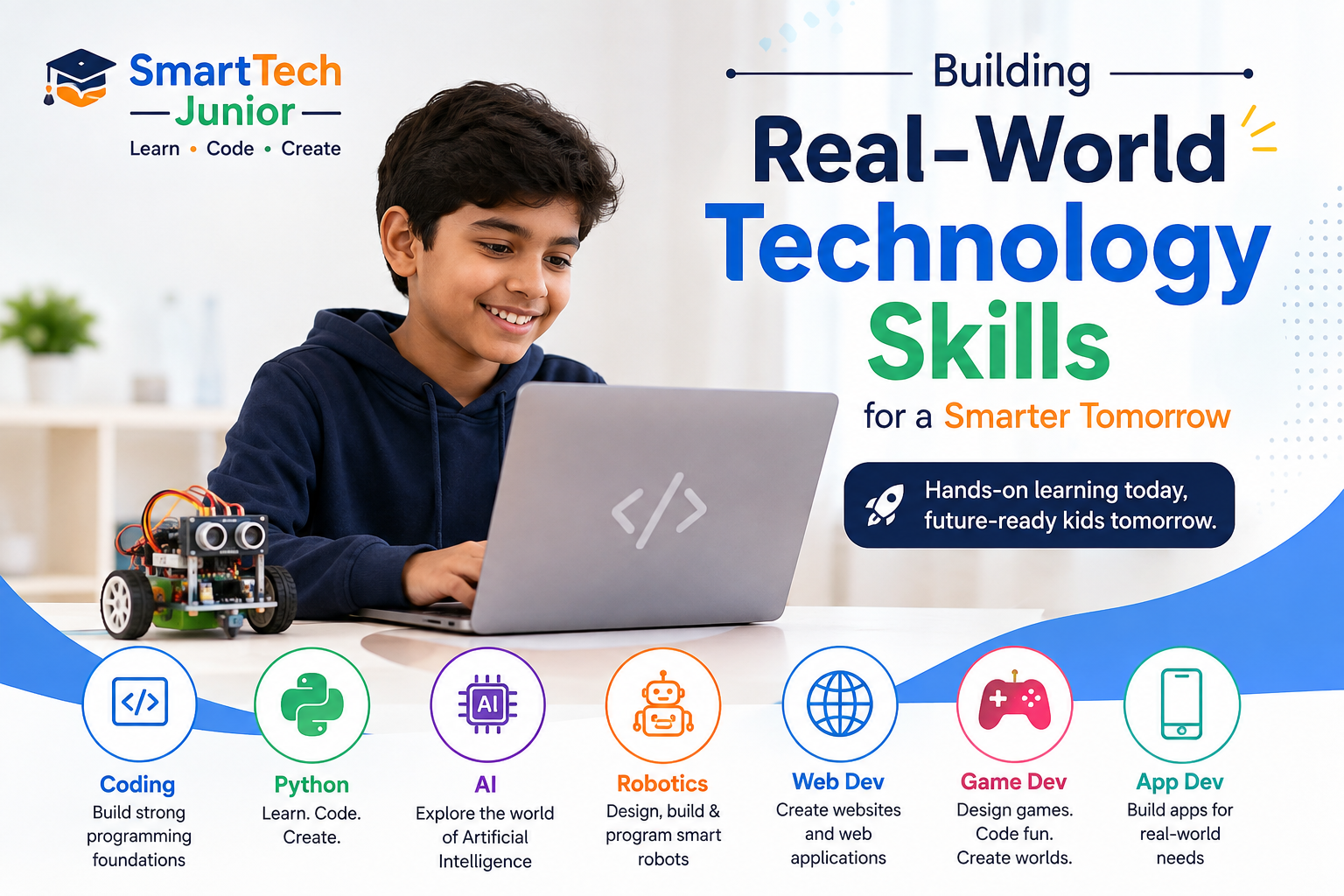
How SmartTech Junior Helps Kids Build Real-World Technology Skills
Technology is no longer limited to computer labs or textbooks. Children today can learn how to create websites, develop applications, build robots, write programs, and explore Artificial Intelligence from an early age.
However, learning technology effectively requires more than memorizing programming concepts. Children need opportunities to experiment, build, solve problems, and turn their ideas into working projects.
This is where SmartTech Junior focuses on practical and project-based technology education.
Learning Technology Through Projects
One of the most effective ways for children to understand technology is by creating something of their own.
Instead of only learning programming concepts, students can apply what they learn to practical projects.
For example, a student learning Python might build a simple game or application. A student learning web development can create a personal website. A robotics learner can design and program a robot.
This approach makes learning more engaging and helps students understand how technology is used in the real world.
Building Strong Coding Foundations
Coding is an important foundation for many technology careers.
SmartTech Junior introduces students to programming concepts in an age-appropriate and practical way.
Students can explore areas such as:
- Programming fundamentals
- Python
- Web development
- Game development
- App development
- Problem-solving
- Algorithms
The goal is not simply to teach students how to write code, but to help them understand how to use coding to solve problems and create useful projects.
Exploring Artificial Intelligence
Artificial Intelligence is becoming an important part of modern technology.
Students can gradually explore AI concepts through age-appropriate activities and projects. This helps them understand how intelligent systems work and how AI can be used to solve real-world problems.
Learning programming alongside AI also provides students with a foundation for exploring more advanced technology in the future.
Learning Through Robotics
Robotics brings software and hardware together.
When students build and program robots, they can learn about:
- Sensors
- Motors
- Electronics
- Programming
- Automation
- Engineering
- Problem-solving
Robotics projects encourage students to experiment, identify problems, test solutions, and improve their designs.
Web and App Development
Creating websites and applications gives students an opportunity to see their ideas become interactive digital products.
Students can learn technologies such as:
- HTML
- CSS
- JavaScript
- App development concepts
- User interface design
- Interactive features
Building a website or application can also help students understand how the digital products they use every day are created.
Developing Creativity Through Game Development
Game development combines coding, design, storytelling, logic, and creativity.
Students can design characters, create game rules, develop challenges, and program interactions.
This makes game development an engaging way to introduce programming while encouraging children to think creatively.
Developing Problem-Solving Skills
Technology education is not only about technical knowledge.
When students work on projects, they often encounter errors and unexpected problems. Instead of simply giving them the answer, guided learning can encourage them to investigate the problem and find a solution.
This helps develop:
- Logical thinking
- Critical thinking
- Creativity
- Persistence
- Decision-making
- Problem-solving
These skills can benefit students both inside and outside the classroom.
From Learning to Creating
A major difference between simply learning technology and truly understanding it is the ability to create something independently.
Students can progress from:
Learning → Practicing → Building → Testing → Improving → Creating
This process encourages children to become active creators rather than passive users of technology.
Preparing Students for Future Technology
Technology continues to evolve, and the skills students need in the future may be different from those required today.
Learning programming, AI, robotics, web development, and other technology concepts gives students a strong foundation for exploring future opportunities.
Possible career areas include:
- Software Development
- Artificial Intelligence
- Robotics
- Web Development
- Game Development
- Data Science
- Engineering
- App Development
Students do not need to decide their future career at an early age. The goal is to expose them to different areas of technology and help them discover what interests them.
Encouraging Independent Learning
Good technology education should also encourage curiosity.
Students should feel comfortable asking questions such as:
- How does this work?
- Can I change it?
- Can I build something different?
- Can I improve this project?
- Can I solve this problem another way?
This curiosity can motivate children to continue learning even beyond their classes.
Why Project-Based Learning Matters
Project-based learning gives students a reason to use the concepts they learn.
Instead of learning coding as isolated commands, students can see how those concepts contribute to a complete project.
This creates a more meaningful learning experience and helps students remember concepts through practical application.
Conclusion
SmartTech Junior focuses on helping children develop practical technology skills through hands-on and project-based learning.
From coding and Python to AI, robotics, web development, game development, and app development, students get opportunities to explore different areas of technology and turn ideas into projects.
More importantly, they develop creativity, logical thinking, confidence, and problem-solving skills that can support them throughout their educational journey.
Learning technology is the first step. Creating with technology is where the real journey begins.