
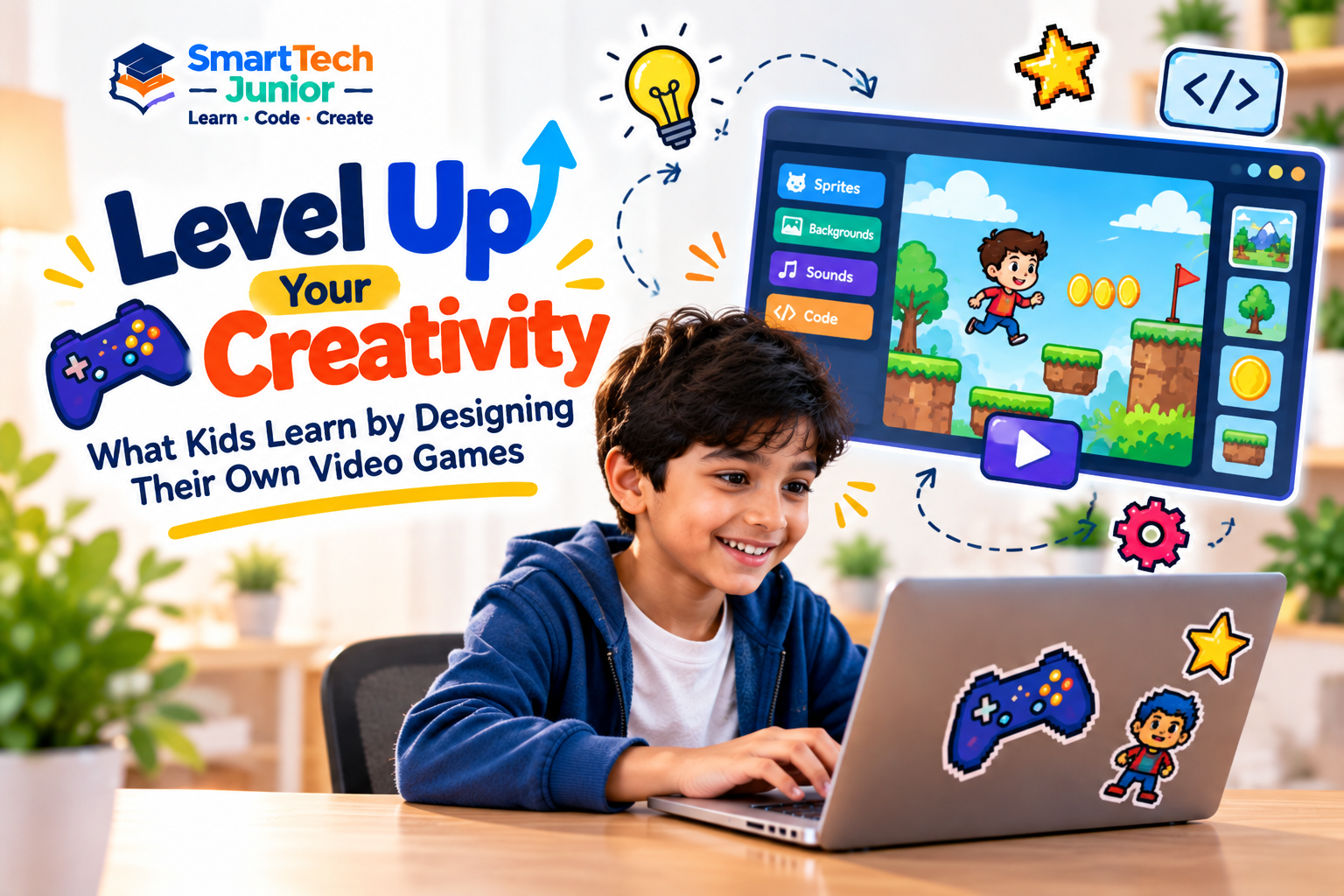
Many children enjoy playing video games, but have you ever wondered what happens behind the scenes when a game is created? From designing characters to building levels and creating scoring systems, game development involves a combination of creativity, planning, and programming.
Learning game development allows children to explore how their favourite games work while discovering how to create their own interactive experiences. Instead of simply playing games, they can begin designing characters, setting challenges, developing rules, and building games based on their own ideas.
At SmartTech Junior, children can explore game development through practical learning activities that introduce them to the creative and technical aspects of making games.
1. Turning Imagination into Playable Games
Every game begins with an idea. A child might imagine a racing challenge, a treasure hunt, a space adventure, or a puzzle-solving game.
Game development teaches children how to transform these ideas into playable experiences. They learn to plan the game environment, decide what players should accomplish, and determine how different elements interact.
For example, a child creating a treasure-hunting game might design a character, place treasures throughout a level, and introduce obstacles that players must overcome.
This process encourages children to think creatively while learning how to organise their ideas into a structured project.
2. Understanding Game Rules and Logic
Behind every video game is a set of rules that determines how it behaves.
What happens when a player touches an obstacle? How does a character earn points? When does a level end? These actions depend on specific instructions and conditions.
Children learning game development begin exploring concepts such as:
- Conditions and decision-making
- Events and actions
- Variables and scoring systems
- Repetition and game loops
- Player movement and interactions
For example, a simple game might increase the player's score whenever a character collects a coin. If the player reaches a score of 10, the game could display a winning message.
By creating these features, children learn how logical instructions control the behaviour of a game.
3. Designing Characters, Levels, and Challenges
A successful game needs more than working code. It also needs interesting characters, engaging environments, and challenges that keep players interested.
Game development introduces children to basic design decisions. They can choose character appearances, create backgrounds, arrange objects, and plan different levels of difficulty.
For example, a platform game might begin with a simple level and gradually introduce moving platforms, additional obstacles, and more challenging routes.
Children learn to consider the player's experience when making design choices. They also discover how visual elements and game mechanics work together to create an enjoyable experience.
4. Learning Through Trial and Error
A game rarely works perfectly on the first attempt. A character might move too quickly, a scoring system might fail, or an obstacle might make a level impossible to complete.
Game development encourages children to identify these problems, test possible solutions, and improve their work.
This process introduces them to debugging, which involves finding and correcting errors in a program.
For instance, if a character continues moving beyond the edge of the screen, a child can investigate the movement instructions and add a condition to keep the character within the game area.
These experiences help develop patience, analytical thinking, and problem-solving skills.
5. Building More Advanced Game Features
Once children understand the basics, they can gradually explore more advanced features.
Depending on their learning level and the tools they use, they may experiment with:
- Multiple game levels
- Timers and countdowns
- Health points and lives
- Increasing difficulty
- Sound effects and animations
- Winning and losing conditions
- Interactive menus and restart options
Each new feature introduces additional opportunities to practise programming and creative design.
For example, a child could create a quiz game in which players answer questions, earn points for correct answers, and progress through increasingly difficult rounds.
Small improvements can gradually turn a basic activity into a more complete game.
6. Developing Skills Beyond Game Development
Learning to create video games can support several useful skills.
Creativity: Children develop original characters, environments, stories, and game mechanics.
Logical thinking: They organise instructions and understand how different actions produce specific results.
Problem-solving: They investigate errors and find ways to improve their games.
Planning: They break a large idea into smaller tasks that can be completed step by step.
Persistence: They learn to test, revise, and improve their work rather than giving up when something fails.
Digital skills: They gain practical experience with development tools and programming concepts.
These skills can support children's learning in other academic subjects and technology-related activities.
7. A Simple Example: Building a Coin Collection Game
Imagine a child wants to create a game in which a character collects coins while avoiding obstacles.
The development process could include the following steps:
Step 1: Create the character
Choose a character and define how it moves across the screen.
Step 2: Design the environment
Add a background, place coins, and introduce obstacles.
Step 3: Create the scoring system
Use a variable to store the player's score and increase it whenever a coin is collected.
Step 4: Add game rules
Program the character to lose a life or restart when it touches an obstacle.
Step 5: Test the game
Play the game, identify problems, and adjust the movement, scoring, and difficulty.
Step 6: Improve the experience
Add sound effects, new levels, or a winning screen.
Through this project, children can explore programming, design, testing, and improvement within a single activity.
8. How Parents Can Support Their Child's Game Development Journey
Parents do not need advanced programming knowledge to encourage their children's interest in game development.
They can begin by asking children to explain their game ideas, demonstrate their projects, or describe how particular features work.
Parents can also encourage children to experiment with different game concepts rather than focusing only on the final result.
Choosing a structured learning programme can provide additional guidance, introduce suitable development tools, and help children progress from simple activities to more challenging projects.
The goal is to help children become active creators who understand how digital experiences are designed and developed.
Explore Game Development with SmartTech Junior
Game development offers children an engaging way to explore the connection between creativity and technology. By designing characters, building levels, programming game rules, and testing their ideas, children can develop practical skills while creating projects they are proud to share.
At SmartTech Junior, students can explore technology through guided learning and hands-on activities suited to their learning level. A structured approach to game development can help children build their understanding step by step, from simple game concepts to more interactive projects.
Instead of only asking how a game is played, children can begin asking a more exciting question: How can I create my own game?
With the right guidance and opportunities to practise, that question can become the starting point of a rewarding learning experience.
Conclusion
Designing video games is an opportunity for children to do more than explore entertainment. It allows them to combine imagination, logical thinking, programming, and problem-solving to create something of their own.
From developing simple game rules to building interactive levels, each project provides an opportunity to experiment, learn, and improve.
Introducing children to game development can help them discover new interests, strengthen valuable skills, and understand the creative process behind the games they enjoy.