
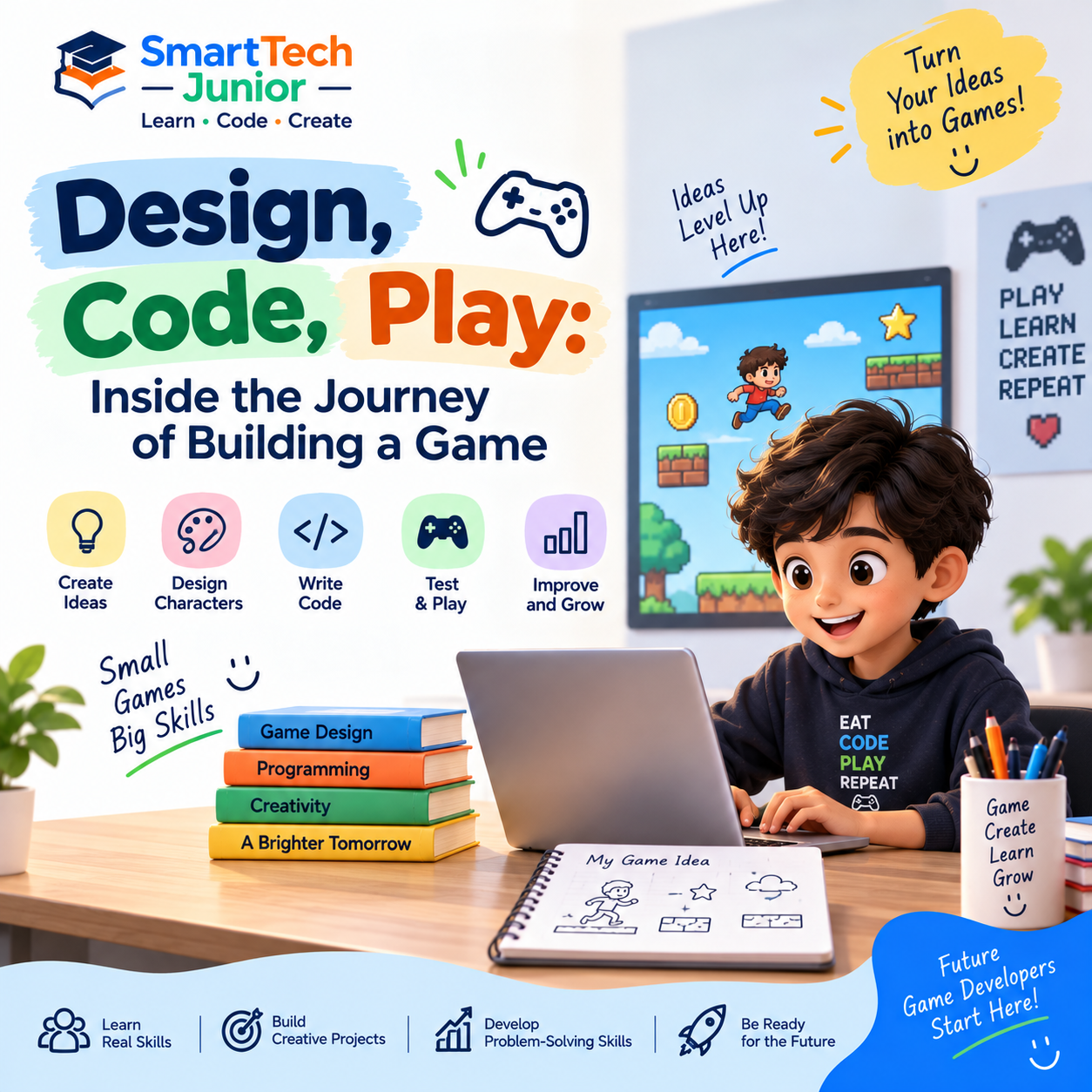
Design, Code, Play: Inside the Journey of Building a Game
Video games are a familiar part of children's digital lives. But what happens when a child moves from playing a game to creating one?
Game development brings together creativity, programming, design, storytelling, and problem-solving. It gives young learners an opportunity to understand how the games they enjoy are designed and built.
Every Game Starts with an Idea
Before writing code, a game begins with an idea.
A young game designer might imagine:
- What is the game about?
- Who is the main character?
- What should the player do?
- What challenges should appear?
- How does the player win?
This stage encourages children to think creatively and turn their imagination into a structured concept.
Designing the Game
Once the basic idea is ready, the next step is designing the experience.
Students can think about:
- Characters
- Backgrounds
- Levels
- Rules
- Challenges
- Rewards
- Player interactions
Design teaches children that creating a good game is not only about making it look interesting. It is also about making the experience understandable and enjoyable for the player.
Bringing the Idea to Life with Code
This is where programming becomes part of the game.
Code can control what happens when a player performs an action.
For example:
Player presses a key → Character moves
Character touches an obstacle → Game responds
Player completes a challenge → Next level begins
Through these interactions, children can see how programming turns ideas into playable experiences.
Game Development Encourages Creativity
Games provide a large space for creative expression.
Students can create their own characters, worlds, challenges, stories, and rules.
Two students can start with the same basic idea and produce completely different games.
This freedom encourages children to experiment and develop their own creative style.
Learning Through Challenges
Game development also involves solving problems.
A character might move incorrectly. A score might not update. A level might not behave as expected.
Students need to investigate what went wrong and find a solution.
This creates a practical way to develop:
- Logical thinking
- Debugging skills
- Patience
- Decision-making
- Problem-solving
Testing Is Part of Creating
A game is rarely perfect on the first attempt.
Developers test their games repeatedly to identify problems and improve the experience.
Young learners can follow a similar process:
Build → Play → Find Problems → Fix → Improve → Play Again
This teaches children that mistakes are a normal part of creating something.
Storytelling Meets Technology
Many games also involve storytelling.
Characters need goals. Players need challenges. Worlds need a purpose.
Creating a simple game story can help children combine writing and creativity with technology.
This makes game development an interesting intersection between technical and creative skills.
What Can Young Learners Build?
Beginners don't need to start with a complicated game.
They can begin with simple projects such as:
- Maze games
- Racing games
- Platform games
- Quiz games
- Puzzle games
- Catching games
- Adventure games
As their skills improve, they can gradually add more features and complexity.
Game Development Builds Confidence
There is something rewarding about seeing a game that you created actually work.
A student can play their own creation, share it with others, and continue improving it.
This sense of achievement can encourage children to take on increasingly challenging technology projects.
Learning Game Development at SmartTech Junior
At SmartTech Junior, game development can give young learners an opportunity to explore programming through creative projects.
Students can learn how game mechanics, design, and programming work together while creating their own interactive experiences.
The focus can move beyond simply learning coding concepts toward using code to build something meaningful and enjoyable.
More Than Just Games
Game development introduces children to concepts that extend beyond the gaming industry.
The same skills involved in planning, designing, coding, testing, and improving a game can be useful in many areas of technology.
Students learn to think like creators:
Imagine → Design → Code → Test → Improve
Conclusion
Building a game is a journey that combines imagination with technology.
From the first idea and character design to coding, testing, and finally playing the finished project, every stage gives children an opportunity to learn something new.
For young learners, game development can transform their relationship with technology—from simply playing digital experiences to understanding how to create them.