
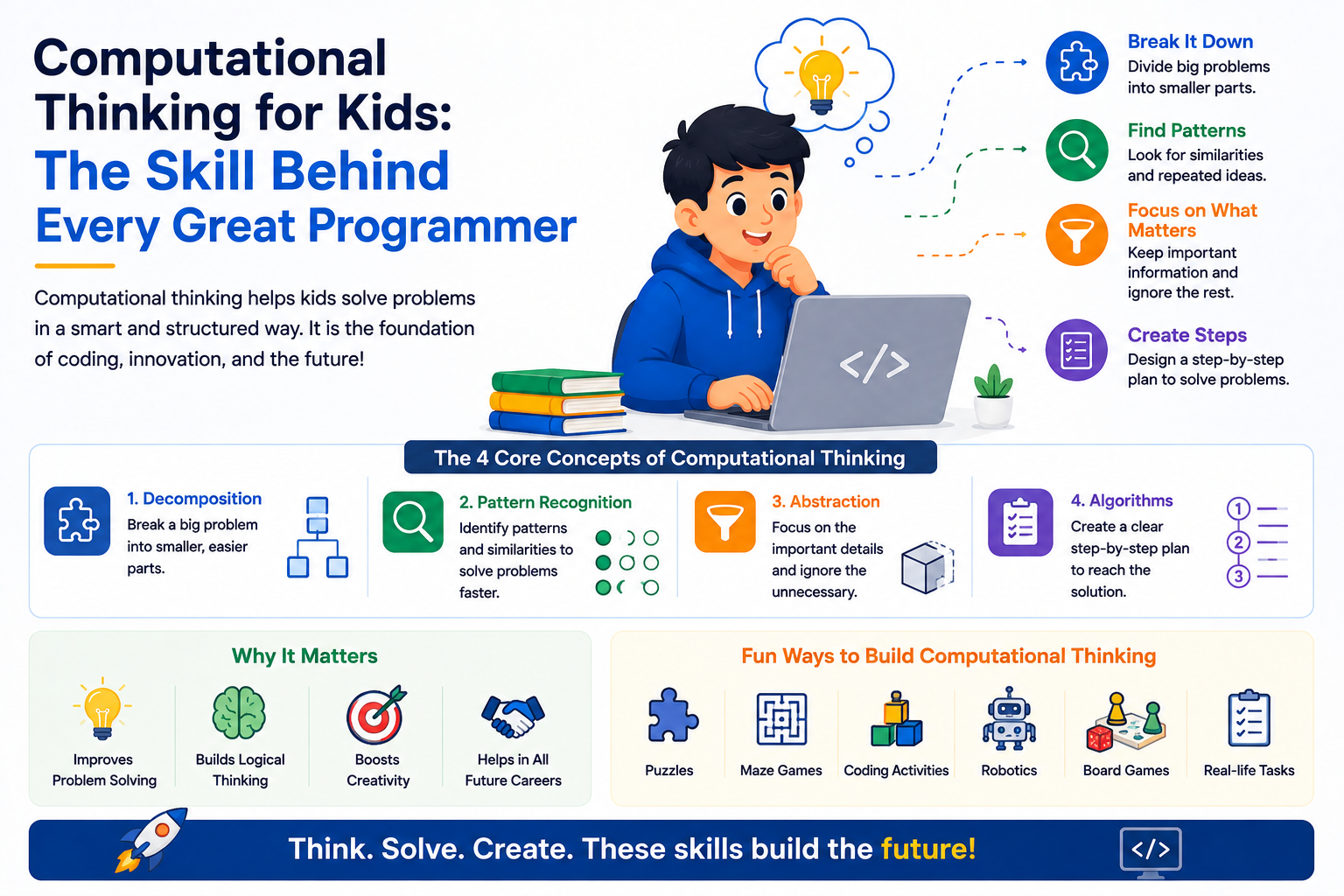
Computational Thinking for Kids: The Skill Behind Every Great Programmer
Learning to code is not just about remembering programming commands. Before writing code, students need to understand how to approach a problem, break it into smaller parts, identify patterns, and create a logical solution.
This way of thinking is called computational thinking.
Computational thinking is one of the most important skills children can develop before and while learning programming. It helps students solve problems systematically and prepares them for coding, Artificial Intelligence, robotics, data science, and many other areas of technology.
What is Computational Thinking?
Computational thinking is a problem-solving approach that helps us understand a complex problem and develop a clear, logical solution.
It does not mean thinking like a computer.
Instead, it means learning how to solve problems in a structured way that can eventually be understood and followed by a computer.
For example, imagine that a student wants to create a simple game.
Instead of immediately starting to code, the student can first ask:
- What is the objective of the game?
- What actions can the player perform?
- What happens when the player wins?
- What happens when the player loses?
- What rules does the game need?
- What steps are required to build it?
This approach is computational thinking.
The Four Main Parts of Computational Thinking
Computational thinking is commonly explained through four important concepts.
1. Decomposition
Decomposition means breaking a large problem into smaller and easier parts.
For example, creating a website may seem like a big task.
A student can divide it into:
- Homepage
- About section
- Images
- Navigation
- Contact form
- Styling
- Interactive features
Instead of solving one huge problem, the student solves several smaller problems.
2. Pattern Recognition
Pattern recognition means identifying similarities or repeated ideas.
For example, when students notice that several programming problems require similar steps, they can reuse the same approach instead of starting from zero.
Recognizing patterns helps students solve problems faster and more efficiently.
3. Abstraction
Abstraction means focusing on the important information while ignoring unnecessary details.
Consider using a mobile application.
A student does not need to understand every technical process happening inside the device. They only need to understand the information required to use or design the application.
Abstraction helps students focus on what matters for solving a particular problem.
4. Algorithms
An algorithm is a step-by-step method for solving a problem.
Even simple everyday activities can be represented as algorithms.
For example, making a sandwich could involve:
- Take the bread.
- Add the filling.
- Add vegetables.
- Place another slice of bread.
- Serve.
Programming works in a similar way. Students create a sequence of instructions that tells a computer what to do.
Why is Computational Thinking Important for Kids?
Computational thinking develops skills that are useful far beyond programming.
It helps children improve:
- Problem-solving
- Logical reasoning
- Critical thinking
- Creativity
- Decision-making
- Planning
- Attention to detail
- Persistence
These skills can also support learning in mathematics, science, engineering, and everyday life.
Computational Thinking and Coding
Computational thinking and coding are closely connected, but they are not the same thing.
Computational thinking focuses on understanding and solving the problem.
Coding focuses on converting the solution into instructions that a computer can execute.
A student who understands the problem first can usually write better and more organized programs.
This is why computational thinking should be developed alongside programming skills.
Simple Activities to Develop Computational Thinking
Children do not need advanced programming knowledge to practice computational thinking.
Parents and teachers can introduce activities such as:
Puzzle Solving
Puzzles encourage children to analyze information and find logical solutions.
Sequencing Activities
Ask children to arrange steps in the correct order for completing a task.
Pattern Games
Give children numbers, shapes, or objects and ask them to identify patterns.
Maze Challenges
Maze activities encourage children to plan a route and make decisions.
Board Games
Strategy-based games encourage planning, logical reasoning, and decision-making.
Coding Projects
Simple coding projects allow children to apply computational thinking to real problems.
Computational Thinking in Robotics
Robotics is another excellent way to develop computational thinking.
When building a robot, students need to think about:
- What should the robot do?
- What sensors are required?
- What should happen when an obstacle is detected?
- What sequence of actions should the robot follow?
- How can the program be improved?
Students naturally practice decomposition, pattern recognition, abstraction, and algorithms while working on robotics projects.
Computational Thinking and AI
Computational thinking also provides a strong foundation for learning Artificial Intelligence.
AI projects require students to understand problems, organize information, identify patterns, and develop logical solutions.
Students who develop computational thinking early can find it easier to understand advanced technology concepts later.
How Schools and Parents Can Encourage It
Computational thinking can be developed through everyday learning.
Parents and teachers can encourage children to:
- Ask questions about how things work.
- Break large tasks into smaller steps.
- Look for patterns.
- Explain their reasoning.
- Try different solutions.
- Learn from mistakes.
- Build small technology projects.
The goal is not always to find the answer immediately. The process of thinking about the problem is equally important.
How SmartTech Junior Develops These Skills
At SmartTech Junior, students learn technology through practical and project-based activities.
Instead of focusing only on programming syntax, students are encouraged to understand problems, plan solutions, experiment with ideas, and build projects.
Through coding, robotics, AI, and other technology activities, students develop both technical knowledge and problem-solving abilities.
Future Benefits of Computational Thinking
Computational thinking can provide a strong foundation for many future learning paths, including:
- Software Development
- Artificial Intelligence
- Robotics
- Data Science
- Web Development
- Game Development
- Engineering
- Cybersecurity
More importantly, the ability to approach problems logically can benefit students regardless of the career they eventually choose.
Conclusion
Computational thinking is more than a programming skill. It is a structured way of understanding problems and finding effective solutions.
By learning decomposition, pattern recognition, abstraction, and algorithms, children can become better problem-solvers and more confident technology learners.
Whether a child eventually becomes a programmer, engineer, AI specialist, designer, or entrepreneur, developing computational thinking today can provide a valuable foundation for the future.