
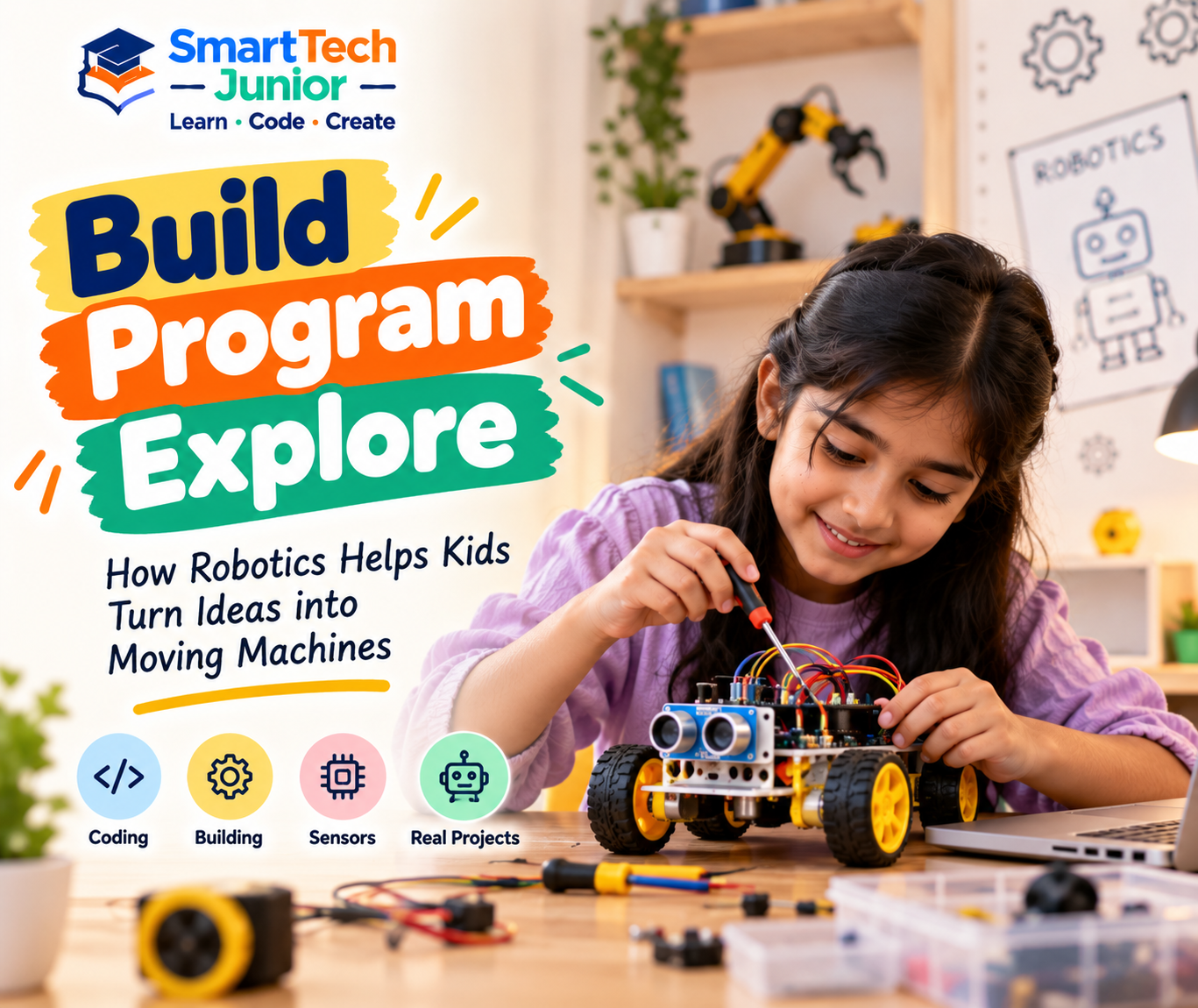
Build, Program, Explore: How Robotics Helps Kids Turn Ideas into Moving Machines
Children naturally enjoy exploring how things work. A moving object, a sensor that detects something, or a machine that responds to an instruction can quickly turn curiosity into a learning opportunity.
Robotics brings together coding, electronics, engineering, and creativity, allowing children to move beyond simply learning concepts and start building things that can interact with the world around them.
What Makes Robotics Different?
Learning programming on a computer teaches children how to give instructions to a machine.
Robotics takes that idea one step further.
A child can write a program and then see the result through a physical robot.
For example, a student might create a program that makes a robot:
- Move forward
- Turn when it reaches an obstacle
- Detect an object
- Follow a particular path
- Respond to sensor input
- Perform a sequence of movements
This connection between code and physical movement can make programming more understandable and engaging.
Robotics Combines Multiple Skills
Robotics is not limited to building robots.
Students can explore several areas of technology at the same time.
Coding helps students control how the robot behaves.
Sensors allow the robot to collect information from its surroundings.
Motors allow the robot to move.
Controllers and electronics connect the different components and allow them to work together.
When students combine these elements, they begin to understand how software and hardware can work as one system.
Learning Through Hands-On Projects
Robotics becomes more interesting when children have a project to work toward.
Instead of simply learning what a sensor does, students can use one to solve a challenge.
For example, they might build a robot that detects an obstacle and changes direction.
A project like this involves several stages:
- Understand the challenge.
- Plan the robot's behavior.
- Connect the required components.
- Write the program.
- Test the robot.
- Find and fix problems.
- Improve the final design.
This makes learning an active process rather than just memorizing information.
What Happens When the Robot Doesn't Work?
Robotics projects rarely work perfectly on the first attempt.
The robot might move in the wrong direction. A sensor might give unexpected results. The motor may not behave as expected. The code may contain an error.
Instead of seeing these problems as failures, students can use them as opportunities to investigate.
They learn to ask:
What went wrong?
Why did it happen?
What can I change?
Does the new solution work?
This process develops debugging and problem-solving habits that are useful far beyond robotics.
Robotics Encourages Creative Thinking
There is often more than one way to solve a robotics challenge.
Students can experiment with different designs, movements, programs, and approaches.
One student may focus on making the robot faster, while another may try to make it more accurate.
This gives children room to develop their own ideas while working within a technical challenge.
From Simple Robots to Bigger Ideas
Children do not need to begin with complicated robotics systems.
Their learning can progress gradually.
They might start by understanding basic components and simple movements. Later, they can explore sensors, conditions, loops, and more complex robotic behaviors.
As their skills grow, projects can become more challenging and creative.
This progression allows students to build confidence while continuously developing their technical abilities.
Why Robotics Can Be a Valuable Skill for Kids
Robotics provides children with an opportunity to combine different areas of learning in one activity.
Through robotics projects, students can develop:
- Programming skills
- Logical thinking
- Problem-solving
- Creativity
- Engineering awareness
- Experimentation skills
- Project-building experience
- Teamwork and communication
The focus is not simply on building a robot. It is about understanding how ideas can become working systems.
Learning Robotics at SmartTech Junior
At SmartTech Junior, robotics can be introduced through practical, project-based learning that encourages children to explore technology by building and experimenting.
Students can learn how coding, sensors, motors, and other components work together while developing their own robotics projects.
The objective is to help children become comfortable with experimentation and understand that technology can be something they build, control, and improve.
From Ideas to Moving Machines
A simple idea can become a physical creation when coding and hardware come together.
Robotics gives children the opportunity to experience that transformation firsthand.
They can build, program, test, and explore while developing skills that extend beyond the classroom.
For a child who enjoys both technology and making things, robotics can be an exciting way to begin the journey from curious learner to young creator.