Technology is becoming an important part of education, communication, creativity, and everyday life. Children regularly interact with digital devices, applications, games, and online platforms, but understanding how these technologies work requires a different kind of learning.
Learning technology is not just about understanding concepts or memorising definitions. It also involves experimenting with ideas, solving problems, developing projects, and discovering how digital tools can be used to create something meaningful.
This is where practical technology education becomes valuable.
At SmartTech Junior, children can explore different areas of technology and begin developing skills that help them move from using digital tools to understanding and creating with them.
Why Practical Technology Learning Matters
Traditional learning often introduces students to concepts before they have an opportunity to apply them. Practical learning connects those concepts with activities that students can see, test, and improve.
For example, a child learning programming can write instructions for a computer, observe the result, and modify the code to achieve a different outcome.
Similarly, a student exploring robotics can investigate how coding, sensors, and motors work together to control a machine.
These experiences help children connect theoretical knowledge with practical applications.
Project-based learning can also encourage students to ask questions, experiment with different approaches, and develop their own solutions rather than simply following instructions.
Exploring Technology Through Different Learning Paths
Every child has different interests. Some enjoy designing games, while others are curious about robots, websites, applications, or artificial intelligence.
Exploring different technology subjects can help children discover what interests them most.
1. Coding: Developing Logical Thinking
Coding introduces children to the process of giving instructions to computers.
Students can learn how to organise instructions, recognise patterns, use conditions, and solve problems step by step.
Through coding activities, children can explore how a simple set of instructions can produce an interactive result.
These foundations can support further learning in programming, software development, and other technology-related subjects.
2. Python Programming: Turning Ideas into Programs
Python is a widely used programming language that can help students progress from basic programming concepts to more advanced projects.
Children can begin with variables, conditions, loops, and functions before applying these concepts to practical programs.
As their understanding develops, they can explore projects such as quizzes, calculators, simple games, and introductory data or AI applications.
The focus is not simply on learning Python syntax. It is on understanding how programming can be used to solve problems and build useful applications.
3. Artificial Intelligence: Understanding Intelligent Technology
Artificial Intelligence is increasingly used in applications that recognise images, process language, analyse information, and generate content.
Introducing children to AI can help them understand how these systems work and where they may be useful.
Students can begin exploring concepts such as data, patterns, machine learning, and AI-powered applications through age-appropriate activities.
They can also learn an important lesson: AI systems can make mistakes, and their outputs should be evaluated carefully.
This encourages children to approach emerging technologies with curiosity and critical thinking.
4. Robotics: Connecting Software with Hardware
Robotics combines programming with physical components to create systems that can interact with their surroundings.
Students can explore how motors create movement, how sensors collect information, and how code controls a robot's behaviour.
Practical robotics activities may involve programming movements, detecting obstacles, or responding to sensor input.
These projects introduce children to the relationship between software and hardware while encouraging experimentation and engineering-based thinking.
5. Game Development: Combining Creativity with Code
Game development gives children an opportunity to combine programming, design, storytelling, and problem-solving.
Students can explore how characters move, how scores are calculated, how game rules work, and how players interact with a digital environment.
Building a game also introduces them to testing and debugging.
A character might move incorrectly or a scoring system might fail to update. Students can investigate the problem, modify their code, and test the result.
This makes game development an engaging way to apply programming concepts.
6. Web and App Development: Creating Digital Solutions
Web and app development introduce children to the process of building digital products that people can interact with.
Through web development, students can explore how HTML structures a webpage, CSS controls its appearance, and JavaScript adds interactive behaviour.
App development introduces ideas such as interface design, navigation, user input, and application logic.
Students can use these skills to create personal websites, educational tools, quizzes, simple applications, and other projects.
These activities help them understand how digital products are planned, developed, tested, and improved.
From Learning Concepts to Building Projects
One of the most important parts of practical technology education is giving students opportunities to apply what they learn.
A project provides a clear purpose for learning a concept.
For example, students studying variables might use them to maintain a game score. A student learning conditions could use them to create a quiz that responds differently to correct and incorrect answers.
Similarly, a student exploring web development might use HTML and CSS to build a personal portfolio website.
These projects connect individual concepts with a larger goal.
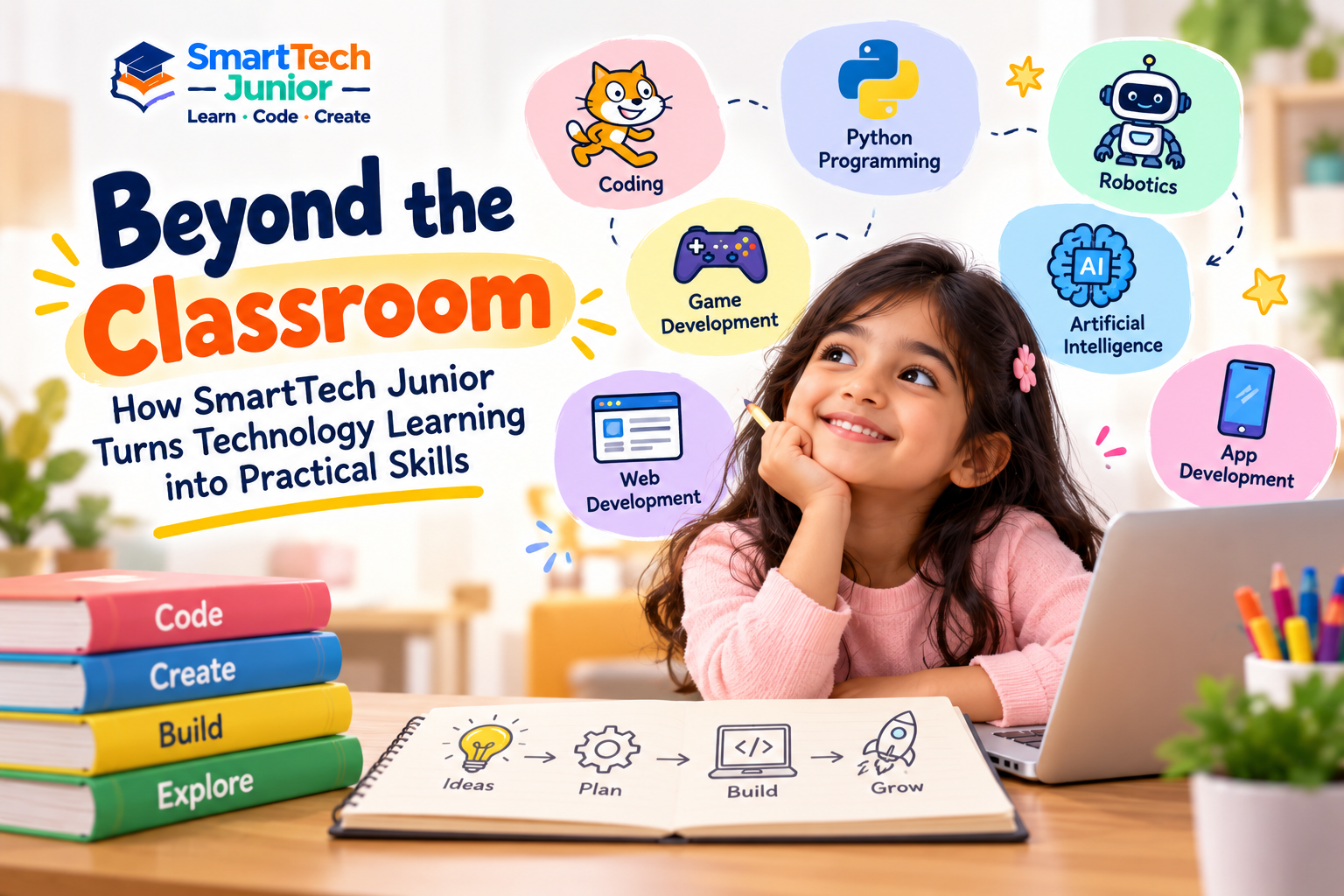
A practical learning process can include five stages:
Understand: Learn the concepts needed for the project.
Plan: Decide what the project should do.
Build: Apply the concepts to create the first version.
Test: Check whether the project works as expected.
Improve: Identify problems, make changes, and refine the result.
Following this process helps students understand that technology creation involves both technical knowledge and continuous improvement.
Developing Problem-Solving and Independent Thinking
Technology projects rarely work perfectly on the first attempt.
Students may encounter errors, unexpected results, or challenges that require them to reconsider their approach.
These situations create opportunities to develop problem-solving skills.
Instead of immediately abandoning a project when something goes wrong, students can learn to investigate the issue, test possible solutions, and evaluate the outcome.
They can also learn to divide complicated tasks into smaller steps.
Over time, these experiences can help students become more comfortable with experimentation and independent thinking.
The same approach is useful beyond technology because many everyday challenges require people to analyse information, evaluate options, and find practical solutions.
Encouraging Creativity and Confidence
Practical learning also gives children room to express their own ideas.
Two students learning the same programming concept might create completely different projects. One might build a quiz, while another develops a simple game or an interactive story.
This freedom encourages experimentation and allows children to make creative decisions.
Completing a project can also give students a visible result of their efforts. They can demonstrate what they have created, explain how it works, and identify what they would like to improve.
These experiences can help them recognise their progress and become more confident in exploring unfamiliar concepts.
Helping Children Prepare for a Technology-Driven Future
Children do not need to choose a technology career at an early age to benefit from learning technology.
Understanding programming, digital design, AI, and problem-solving can help them become more informed and capable technology users.
For students who later decide to pursue computer science or another technology-related field, early exposure can provide a useful starting point.
Practical technology education can help children develop:
- Programming fundamentals
- Logical and computational thinking
- Creative problem-solving
- Digital literacy
- Project planning
- Testing and debugging skills
- Confidence in experimenting with new tools
- An understanding of how digital products are created
These skills can support continued learning as technology evolves.
How SmartTech Junior Supports Practical Technology Learning
SmartTech Junior focuses on helping students explore technology through structured learning and practical activities.
Its learning areas include coding, Python programming, artificial intelligence, robotics, game development, web development, app development, and other creative technology subjects.
By exploring these areas, students can discover different ways to use technology and begin building projects that reflect their interests.
The learning journey can start with simple concepts and progress towards more challenging activities as students develop their understanding.
For parents, this provides an opportunity to introduce children to technology in a structured learning environment where curiosity, practice, and project development can work together.
Choosing a suitable learning path depends on a child's age, current experience, interests, and learning goals. Starting with an engaging subject and building skills gradually can make the experience more approachable.
Beyond the Classroom: Learning by Creating
Technology education becomes more meaningful when children have opportunities to put their knowledge into practice.
Learning a programming concept is a starting point. Using it to build a game, create a website, control a robot, or develop an application allows students to explore what that knowledge can accomplish.
At SmartTech Junior, children can begin exploring these possibilities through technology-focused learning and practical projects.
The objective is to help young learners move beyond simply using technology and discover how they can understand, create, test, and improve it.
Because the future of technology is not only about knowing how to use digital tools. It is also about developing the skills and confidence to create something new with them.