
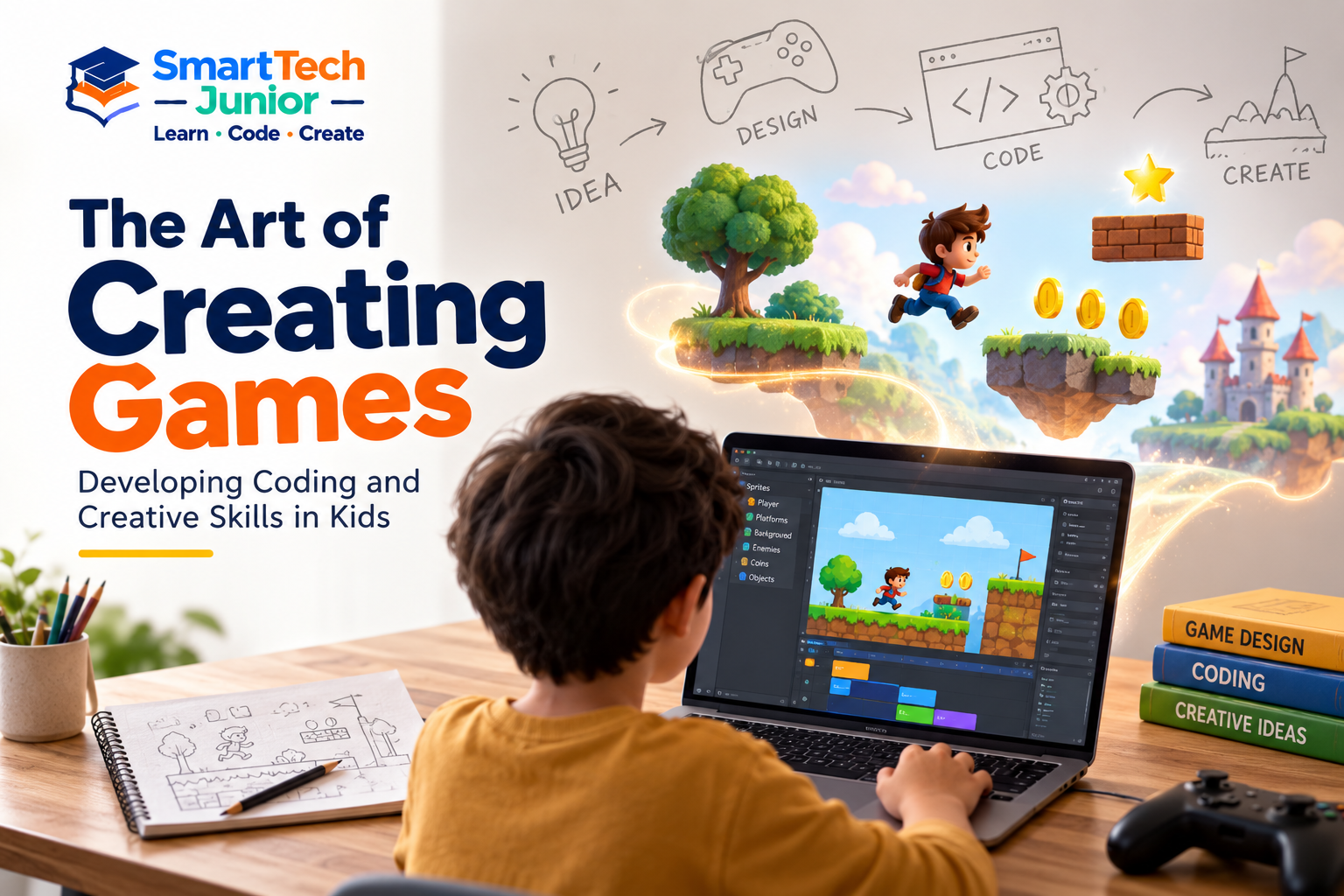
The Art of Creating Games: Developing Coding and Creative Skills in Kids
Games are a familiar part of children's digital lives. They play games on computers, tablets, phones, and consoles, but playing is only one side of the experience.
Behind every game is a combination of ideas, design, storytelling, programming, graphics, and testing.
Learning game development gives children the opportunity to explore what happens behind the screen and discover how their own ideas can become interactive experiences.
From Playing Games to Understanding How They Work
When children play a game, they interact with characters, levels, challenges, scores, and rewards.
Game development allows them to look at these elements from a different perspective.
They can begin asking:
- How does the character move?
- How does the game know when I score?
- What happens when a player reaches the next level?
- How are game rules created?
- How can I design my own game?
These questions introduce children to programming concepts in a creative and practical environment.
Coding Becomes Part of the Creative Process
Game development gives programming a purpose.
Instead of learning code only through isolated exercises, students can use programming concepts to make something happen inside a game.
For example, coding can control:
- Character movement
- Player scores
- Game levels
- Enemy behavior
- Collisions
- Timers
- Lives and rewards
- Game conditions
Concepts such as variables, loops, conditions, events, and functions can become tools that help students bring their game ideas to life.
Creativity Has a Role in Every Game
A game is more than its code.
Children can make creative decisions about the world they want to build.
They can think about:
- What is the story?
- Who are the characters?
- What does the game environment look like?
- What challenges should players face?
- What happens when the player wins?
- What makes the game interesting?
This allows students to combine technical learning with imagination.
Learning Through Game Projects
Project-based learning can make game development especially engaging for young learners.
A student might begin with a simple idea such as a maze game.
They can then gradually add:
- A player character
- Movement controls
- Obstacles
- A scoring system
- Different levels
- Winning and losing conditions
- Sound or visual effects
Each new feature introduces another opportunity to learn and experiment.
The finished game becomes a practical demonstration of what the student has learned.
Problem-Solving Through Game Development
Game development also involves plenty of problem-solving.
A character might move incorrectly. A score may not update. An obstacle might not behave as expected.
Students need to investigate the problem and find a solution.
This process introduces them to debugging, an important part of programming.
Instead of being discouraged when something doesn't work, students can learn to test different solutions and improve their projects.
Storytelling Meets Technology
Games can also help children explore storytelling.
A game can have a beginning, a challenge, and a goal.
Students can create characters with different roles and design environments that support their stories.
This combination of storytelling and programming helps children understand that technology can be used not only to solve problems but also to express ideas.
Building Confidence Through Creation
Creating a working game can give children a tangible result from their learning.
They can see their character move, interact with objects, collect points, or complete a level based on code they created.
This can make programming feel less abstract.
As students build more projects, they can gradually become more comfortable experimenting with new ideas and solving technical challenges.
What Skills Can Kids Develop Through Game Development?
Game development can bring together several valuable skills, including:
- Programming fundamentals
- Logical thinking
- Problem-solving
- Creativity
- Storytelling
- Digital design
- Debugging
- Project planning
- Experimentation
- Technical confidence
These skills can be developed naturally as students work toward creating something they find interesting.
Why Game Development Can Be a Great Learning Experience
Children often learn effectively when they have a reason to use what they are learning.
Game development provides that context.
A programming concept becomes a way to control a character. A variable becomes a score. A condition becomes a game rule. A loop can control repeated behavior.
This makes abstract programming concepts easier to connect with a visible result.
Learning Game Development at SmartTech Junior
At SmartTech Junior, children can explore game development through practical learning and creative projects.
Students can learn how games are planned, designed, programmed, tested, and improved while developing their own interactive creations.
The learning process can help children understand that creating technology involves more than writing code. It involves thinking creatively, solving problems, experimenting, and turning an idea into something people can interact with.
From Imagination to Interactive Experiences
Game development brings together the creative and technical sides of learning.
A simple idea can become a character. A character can become part of a story. Code can turn that story into an interactive experience.
For children interested in both creativity and technology, game development can provide an engaging way to learn programming while creating something of their own.
The goal is not simply to teach children how to make games. It is to help them discover the creative possibilities that come with learning to code, design, experiment, and create.